
Salem's City Directory Holdings
Salem's historical directory shelf is broad, but it is not a single uninterrupted run. The Salem Public Library describes physical and digital coverage from 1836 through 1999 with gaps, while its reference page provides divided scans that are easier to search in a browser. The Massachusetts State Library's Salem inventory fills out many additional holding years. Salem researchers should start with the closest year to a known address or event, then check the prior and following volume instead of treating one absent listing as a final answer.
| Collection | Years | Where Held | Access |
|---|---|---|---|
| Salem directory collection | 1836-1999, with gaps | Salem Collection Room and library digital holdings | Name, street/householders, business, and city-information sections |
| Digitized Salem directory files | Linked years from 1866 through 1946 | Salem Public Library Reference | Free scans, often divided by section for browser searching |
| State Library directory inventory | 1837 through 1983 in listed runs | Massachusetts State Library | Use the inventory's holding and format notes before a visit |
| Salem voting lists | Selected years, 1939-1989 | Massachusetts State Library inventory | Historical civic-registration context, not a current voter list |
Digital access is only one route. The Salem Collection Room can supply physical copies and explain a missing volume, while the State Library inventory is the better check when a Salem year is not on the library's scan page. Historical voting lists add period context, but they should not be read as proof of a modern address.
Salem Historical Directory Shelf
The Salem library's local-history collection does more than hold alphabetic name lists. Its digitized materials include directories, street material, local-history books, landmarks, postcards, and Salem High School yearbooks. A Salem name that is hard to place in a directory can be checked against a yearbook, a local-history text, a newspaper notice, or a street index. The Salem Room at 370 Essex Street is the practical fallback when a scan is difficult to read or a linked year is absent.
See the Salem Public Library's city-directory collection before working through an online volume. The divided files show the years that are immediately available and preserve the street and householders' sections that turn an address into a historical research lead.
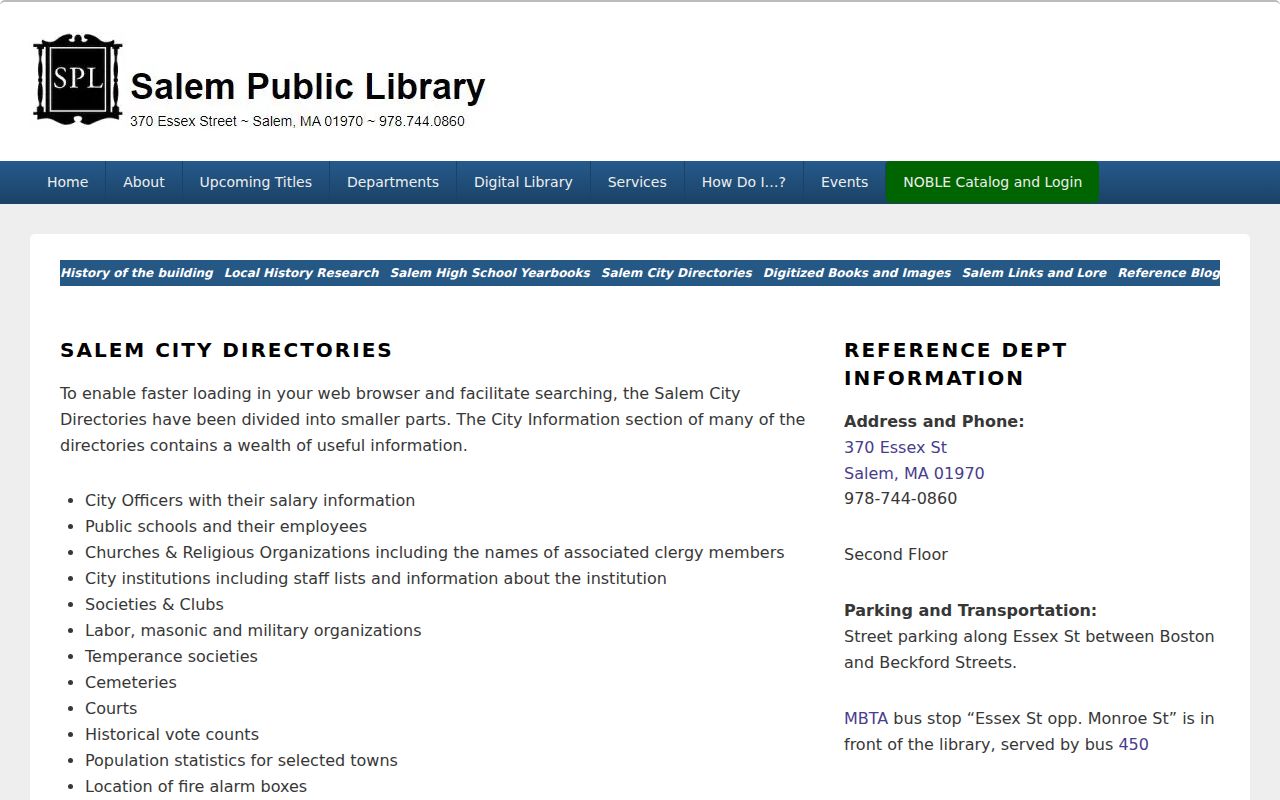
The Salem library landing page is a useful starting point because a directory often has separate files for its name list, street material, and other local sections. Keep the Salem volume year and the section used with every note.
Note: A library-card service or database availability can change, so confirm current access terms with the library before relying on a vendor resource.
Salem Street and Householder Listings
A Salem city directory supports two distinct directions of research. Alphabetical name listings move from a person to a printed address. The Salem street and householders' material moves from an address to the people listed there in that year. The 1895-96 library description says the street directory identifies each street's location and the streets or places that run from or across it, which makes it helpful when the printed street form differs from a modern address.
Salem names require patience. Women may appear under birth, married, or widowed surnames; initials and middle names can shift; and a business may appear in a business directory rather than under an individual. A Salem street section can supply a second check, but it is a year-specific occupant source, not title evidence. For current parcel and deed research, use the Salem Street Directory instead of extending an old entry into a present-day claim.
- Record the name exactly as printed, including initials and punctuation.
- Copy the street number, street name, and any occupation or business context.
- Check the street section and the alphabetical list for the same year.
- Search the years immediately before and after a disappearance or move.
How a Salem Directory Entry Reads
An entry should be transcribed as evidence from one volume, not converted into a modern profile. The 1884 directory's visible structure includes a street directory, name listings, business directory, city information, and surrounding-town material. Other Salem volumes can include government officers, schools, churches, societies, cemeteries, ward boundaries, and advertisements. Those sections help identify context when a common name appears more than once.
| Printed name | Use the spelling, initials, and surname form from the volume; compare variants in nearby years. |
|---|---|
| Address | Copy the house number and street as printed, then use the street index where a name or place form is unfamiliar. |
| Occupation or business | Treat it as a same-name clue, especially when a second person has a similar name. |
| Street section | Read address-first household listings separately from the alphabetical name listing. |
| Marks and abbreviations | Check the key in that exact volume. A mark may indicate a relationship, residence, or other convention, and it should not be carried over from another year without verification. |
- Criss-cross directory
- A common term for a reverse, address-order directory. Salem's street and householders' sections provide the local address-first function, but the volume's own label should be preserved.
- Householder index
- An arrangement that helps connect a street address to the person or household printed at that address for a particular year.
- Abbreviation key
- The volume's explanation of shortened labels and marks. Read or photograph it before interpreting an entry.
A Salem city directory entry identifies what that particular Salem volume printed. Confirm title through the Southern Essex Registry of Deeds and distinguish a record owner from a directory occupant.
Salem's 1884 Directory Volume
The 1884 Salem volume calls itself the twenty-first volume and names Sampson, Davenport & Co. in its preface. It says every building within Salem had been visited, retained an improved street directory, and included an index. Its number table reports 12,887 Salem names, including 705 people marked removed or deceased, within a larger volume total of 27,217 names across its communities. Those figures describe that publication, not the number of people who were necessarily living in Salem at one moment.
The volume is particularly useful as a reminder that a Salem directory can preserve more than a name and house number. Its city-information, business, and surrounding-town sections can explain an occupation, organization, or place reference found in an alphabetic entry. The exact entry key and page context still matter. A removed or deceased notation should be read with the printed date and then checked against a vital, obituary, cemetery, or probate source.
Note: A Salem removed or deceased notation is evidence from that edition, not a substitute for a Salem vital record or probate file.
Salem House Histories and Directories
Historic Salem, Inc. makes a useful companion source for an address-led Salem family question. Its house-history project consists of 33 binders prepared for historic plaques from 1966 onward. Some binders include deed scans, atlases, Sanborn maps, property-line plans, and directory clues; later histories may be narrative. That mix can help explain why a Salem directory uses an older street form or why a household appears at an address for only a short span.
The Salem Historical Society resource page describes the local genealogy support and points researchers toward the Historic Salem house-history database. Treat a binder as a lead to verify through its cited record, especially where it summarizes an ownership trail.
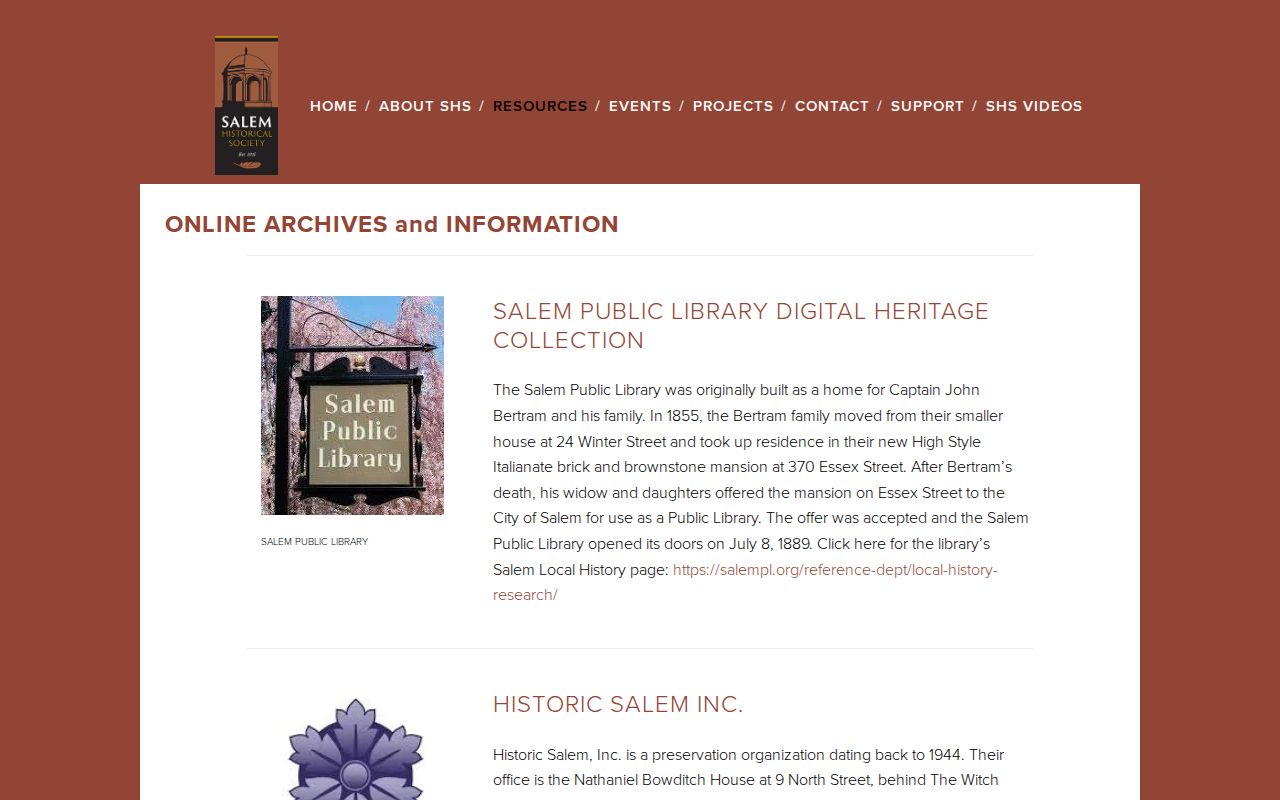
The Salem house-history material is strongest when paired with the directory year, a map or atlas, and the underlying deed or parcel reference. It preserves a human-scale route into a Salem address without turning a historical listing into proof of current residence.
Tracing Salem Directory Families
Follow a Salem household in both directions, not only forward. Begin with a known appearance, record the printed details, and compare adjacent directory years. Pair the Salem sequence with released federal census schedules from 1880 through 1960, where the 72-year federal release rule permits access. Census household composition and age clues can separate people with the same name, but a census is not a current-address source.
- Find the surname and any initials in the closest available Salem directory year, then record the full entry and page or file section.
- Check the street and householders' listing for the same address and note any other printed occupants or businesses.
- Move to the next and prior available volumes, watching for a changed surname, street spelling, or occupation.
- Compare a census decade, obituary, probate file, cemetery reference, or deed only after the directory trail fixes the correct person and year.
- Keep a gap as a gap. A missing entry can reflect removal, death, a directory omission, an address change, or a volume gap.
A later directory finding may need confirmation through a court, property, or vital-record channel. When the task shifts from historical context to one named person's official records, use the Salem Resident Lookup path rather than assuming an old listing settles the question.
Salem Directory Time Markers
Salem became a city in 1836, and the State Library inventory identifies a Salem directory for 1837. The library's broader metadata describes the directory collection as 1836-1999 with gaps. The 1884 volume's designation as the twenty-first volume shows an established nineteenth-century publishing practice, while the library's linked scans create a later digital access layer. These are collection landmarks, not a claim that every year or every person is represented.
| 1836 | Salem became Massachusetts' second incorporated city. |
|---|---|
| 1837 | The State Library inventory lists a Salem directory for this year. |
| 1884 | The scanned volume identifies itself as the twenty-first and names Sampson, Davenport & Co. |
| 1836-1999 | Library/NOBLE metadata gives this collection span, while acknowledging gaps. |
Salem's records history is layered. Municipal archives, nineteenth-century commercial directories, deed index books, maps, yearbooks, and current digital collections each preserve a different piece of a resident trail. Cite the year, printed page or file, and custodian so another researcher can retrace the finding.
Note: The 1914 Great Salem Fire altered the built environment, especially in the Point, but the research does not establish that a specific directory or clerk record run was lost.