
Salem Previous Residents Sources
A backward Salem address trail begins with the current parcel as a fixed point, not with a modern street spelling alone. Record the Salem assessor parcel ID, situs number, owner string, mailing address, sale date, book and page, and legal reference. Then choose the Salem record layer that suits the period. Previous residents are usually found in a chain of dated sources, not in one complete historical roster.
| Source | Located coverage | Where held | What it contributes |
|---|---|---|---|
| Registry deed images | 1640 to present, advertised | Southern Essex online and in person | Recorded instruments, parties, dates, and legal descriptions. |
| Electronic deed index | 1951 to present display | Southern Essex search | Faster name, date, and document-type searching. |
| Historic index books | 1640-1979 image groups | Southern Essex portal | Manual grantor and grantee searching for earlier instruments. |
| Salem city directories | 1836-1999, with gaps | Salem Public Library and State Library | Address-to-occupant and name-to-address snapshots. |
| Federal census | Released schedules through 1950 | National Archives and library resources | Household composition at the census date. |
| HSI house histories | 33 binders compiled from 1966 forward | Historic Salem, Inc. and Omeka | Selected deed, atlas, Sanborn, plan, and directory leads. |
A current Salem owner entry starts an ownership search. A Salem directory or census entry answers a different question: who was listed at that address during a particular year. Keep those labels separate throughout the Salem previous residents search.
Salem Past Residents Parcel Start
Salem Patriot WebPro is the modern bridge. A Salem result can show parcel ID, location or situs, owner, building information, sale date and price, and book and page. Historic Salem property cards, deeds, and street cards are organized by parcel ID. The assessor’s mailing address is where tax correspondence goes, not proof that the owner occupied the listed Salem situs.
In Salem, values are assessment values, not sale-price proof. Likewise, an exemption may support an owner-occupancy inference but cannot establish the people who lived there. Past-resident research should retain the printed record role, its date, and the source identifier rather than turn a tax entry into a household list.
Salem Past Residents Deed Chain
Move from the current Salem parcel’s book and page to the recorded instrument. Read the parties, recording date, consideration, legal description, plan reference, prior deed citation, and mortgage or release references. The seller or grantor in one deed becomes the earlier grantee to test. A legal lot or plan can continue the Salem search when an old document does not use the current house number.
- Capture the current parcel ID, situs, owner string, book and page, and legal reference from WebPro.
- Open the deed through the Southern Essex Recorded Land search and note the prior-deed reference.
- Search the seller as a grantee, then open that earlier purchase instrument.
- Repeat the prior-deed and party check, preserving the date, book and page for each link.
- When the online name index fails, move to the appropriate historic index-book image and read adjacent index pages manually.
- Grantor and grantee
- The grantor transfers an interest. The grantee receives it. Their roles can change with each deed.
- Chain of title
- A dated sequence of recorded transfers used to trace ownership of the same legal property.
- Legal description
- The lot, metes-and-bounds, subdivision, or plan wording that identifies land in a deed more reliably than a changing street address.
- Book and page
- The Registry reference that leads back to a specific recorded instrument or plan image.
Note: Southern Essex displays electronic deed indexes from 1951, while older searches may require index-book images even though record images reach back to 1640.
Salem Past Residents Index Books
Older Salem deed work has a distinct detour. Southern Essex makes historic book-image groups available for Salem work in 1640-1799, 1800-1854, 1855-1950, 1951-1963, and 1964-1978. The electronic name index begins later than the image collection. A negative modern name search does not mean there was no deed, and an address-field search is not a substitute for reading the older grantor and grantee indexes.
Registry Plans and Engineering searches add another bridge. Their advertised images and indexes date from 1741 forward, with owner, street, surveyor, and local modes. Use a plan, atlas, or legal description when a lot was subdivided, a number changed, or a deed refers to a tract rather than a street address.
For an official view of these routes, use the Salem Historical Society’s deed research guidance before choosing between a modern record search and historic index books.
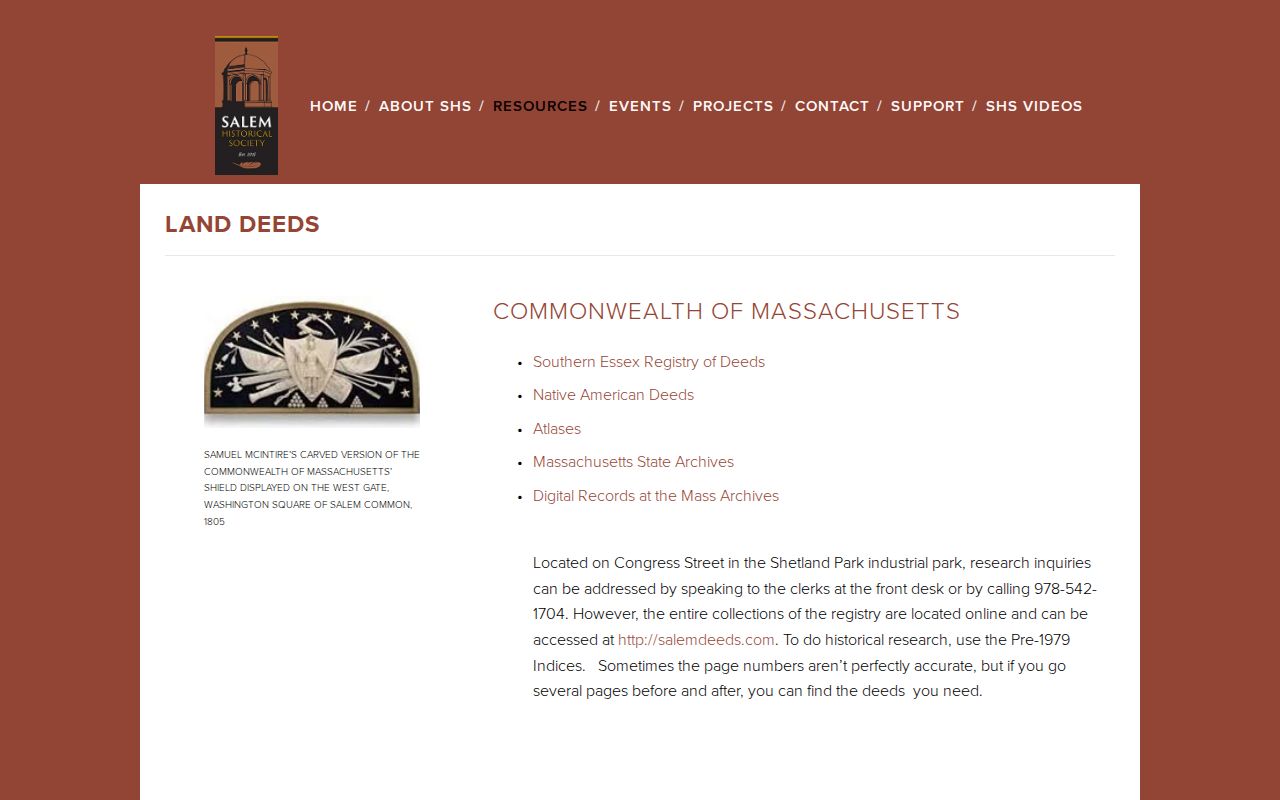
The guidance is useful as a research orientation. For a Salem transfer, the recorded image and its index reference remain the evidence.
Salem Past Residents Address Changes
Address continuity is a Salem research problem, not a reason to guess. A present Salem number can stand on a subdivided parcel. A deed may use a former owner’s name or a legal lot. Directory years can be missing. The 1914 Great Salem Fire changed the built environment in the Point, but no source located for this research establishes a specific clerk or deed-record loss. Use the directory street index, assessor historic card, Registry plan, and MACRIS form to test an apparent break.
Salem’s library materials say the 1895-96 street directory shows where streets run from or across. That is why an old street spelling or place name belongs in the worksheet. For Salem address work, preserve it even when a current postal form standardizes the same road differently.
Salem Past Residents House Histories
Historic Salem, Inc. provides a particularly local Salem address layer: 33 house-history binders prepared for historic plaques, with different combinations of scanned deeds, atlases, Sanborn maps, plans, directories, and narrative details. The material was compiled from 1966 forward and is selective, so an address without a binder is not evidence that its history is absent.
The Salem Historical Society can point researchers to repositories and facilitate professional local-history research for a fee. Salem Public Library’s street and neighborhood guide adds historical atlases and an architecture lead. These channels are the appropriate fallback when the online deed and assessor route does not explain a property’s earlier form.
See the Salem Public Library street and neighborhood research page for the local-history starting point.
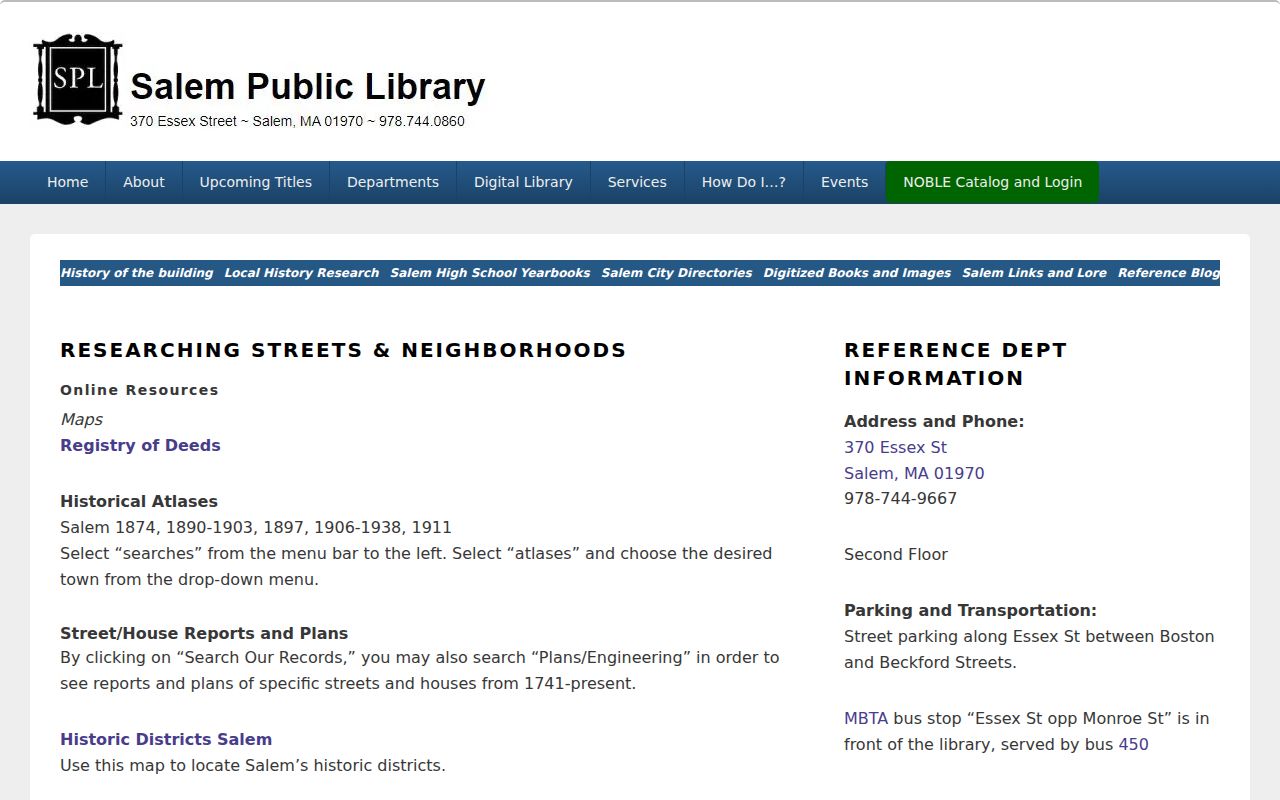
For Salem research, library help can clarify a missing directory volume, a former street name, or the right atlas without converting an uncertain address into a false match.
Salem Past Residents Household Trail
Ownership is only part of the Salem address history. Salem city directories run from 1836 to 1999 with some gaps, and their street or household sections can supply a historical occupant snapshot. The federal census schedule then tests the Salem household at a census date. A disappearance can mean a move, death, omission, directory gap, or address change. It does not prove a person left without another record.
- Record the address, street suffix, name spelling, household notation, and occupation exactly as printed in a directory.
- Check the next and prior available directory years, then search the alphabetical name listing for spelling and surname variants.
- Pair the result with the nearest released census schedule, preserving the census year and household members separately from the directory entry.
- Use a deed, parcel, obituary, probate docket, cemetery lead, or newspaper notice to explain a change rather than assuming a cause.
The collection years, digitized volumes, and how the entries read are detailed in the Salem Directory Book. Here, the volumes serve the backward trail of one address.
Salem Past Residents Endpoints
Obituaries and probate often close a Salem gap that deeds and directories leave open. Funeral-home obituary archives and the Salem News, which the library says runs from 1888 forward, can provide a death date, relatives, former address, and service details. Essex Probate and Family Court files can identify a personal representative, heir, or final-address clue when the docket and access rules permit. Previous residents research should check those Salem sources against a vital record or recorded instrument.
Salem Inspectional Services adds building dates and project participants when a released permit, inspection, certificate of occupancy, or enforcement record is relevant. For a Salem building, utility customer histories are not public. A permit can date construction or change of use, but it is not a list of everyone who lived in the building.
For an event that may explain a household change, the Salem City Clerk is the local registrar for births, deaths, and marriages. Salem makes records from 1634 through 1900 available for genealogy, while later local records are closed and require staff assistance. A mail request can give the name and event date, or an approximate range for genealogy work, and the city lists a $10 local-copy fee. A Salem event is not proof that the person later lived at the address, but an event date can guide the next directory, obituary, probate, or deed search.
Salem Past Residents Privacy
A historical address search should minimize personal details and state the source’s limits. Massachusetts has privacy exemptions under M.G.L. c. 4 §7(26), confidential voter registration rules, and an Address Confidentiality Program. Sealed or restricted vital, court, and voter material does not become open merely because a related deed or directory entry is public. If a current record is wrong, ask the specific custodian to correct it.
Lawful use. Salem past-resident research can support house history, family history, estate work, and personal curiosity. Do not use historical or current records to harass, stalk, or harm anyone.
Preserve uncertainty. A useful worksheet keeps the current parcel ID, prior deed references, party roles, directory occupant, census household, permit date, obituary or probate endpoint, and a note about any negative search.